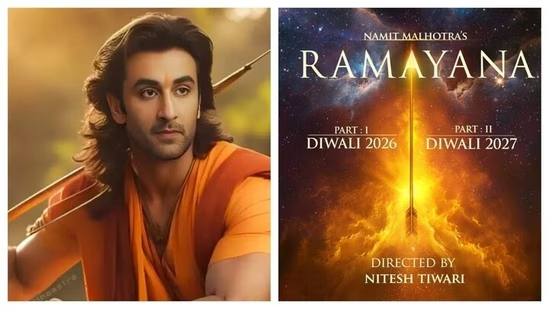
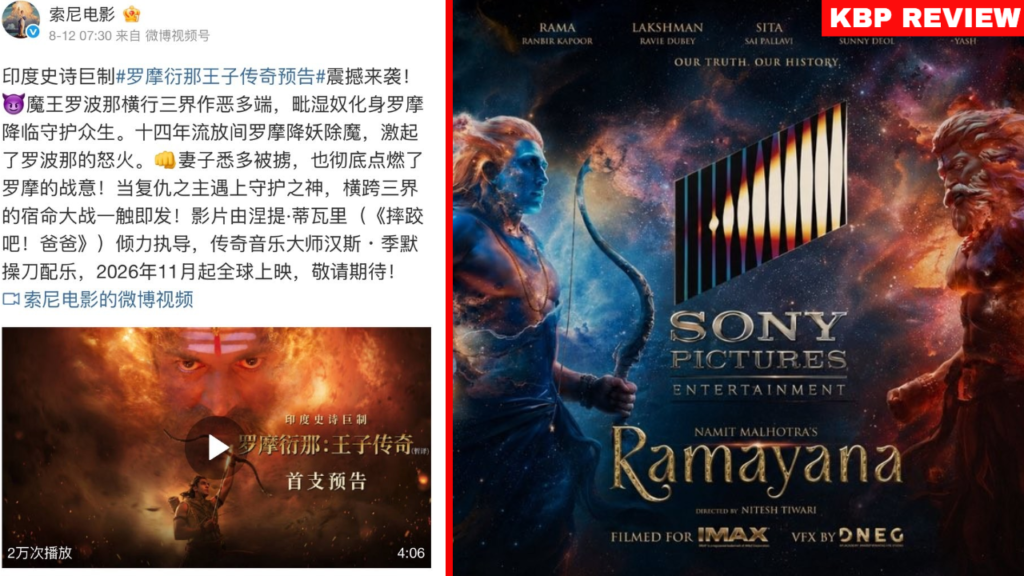
Ramayana is no longer being positioned simply as a big Indian film. With Sony Pictures coming on board as the film’s international distributor, the Ranbir Kapoor, Yash, Sai Pallavi starrer is now being prepared for a genuinely global theatrical journey and China could become its most important overseas markets.
According to the KBP REVIEW latest information the film’s international campaign, Ramayana: Part One is set for a November release in China with official title called “ RAMAYANA: THE LEGEND OF PRINCE ”, adding another major territory to the film’s worldwide rollout.
The development is particularly significant because China has historically been the strongest overseas markets for select Indian films, and the country already has a connection with director Nitesh Tiwari through Dangal.
The Chinese market has begun taking notice of the project as well, with local media highlighting the connection between Ramayana and Dangal director Nitesh Tiwari.
The film’s international campaign is therefore not simply about taking an Indian-language blockbuster to the diaspora; the larger ambition appears to be introducing the story to mainstream audiences across different territories.
There is, however, one important point that needs to be kept clear: Sony Pictures has officially confirmed its role as the global distributor of Ramayana outside India, but a specific China release date and the reported Chinese title should be treated as part of the emerging international rollout until formally announced by Sony or the Chinese distributor. Sony’s global partnership itself is official.
Sony Pictures Gives ‘Ramayana’ A Truly Global Push – The biggest development in Ramayana’s international journey came in July when Prime Focus Studios officially announced its partnership with Sony Pictures. The Hollywood studio will handle the film’s theatrical distribution outside India, marking a major step for an Indian production attempting to enter the worldwide mainstream market.
This is much bigger than simply finding an overseas distributor for an Indian blockbuster. Sony is a major global studio with an established theatrical network, and its involvement gives Ramayana access to markets that traditionally receive Indian films primarily through diaspora-focused distribution.
The film will also be released in multiple language versions, including English, an important part of the makers’ strategy to make the epic accessible beyond Indian audiences. Screen reports have confirmed that Sony will handle the international rollout and that the film is planned for a worldwide November opening.
Producer Namit Malhotra has made no secret of this ambition. His stated vision is to present the Ramayana as a story with universal human values while giving it the kind of cinematic treatment normally associated with major international event films.
Why China Matters So Much China is a particularly interesting market for Ramayana because Indian cinema has already demonstrated that the right story can travel exceptionally well there.The biggest example is Dangal, also directed by Nitesh Tiwari. The Aamir Khan starrer became a phenomenal success in China after its release, turning Tiwari into a filmmaker whose name is already familiar to a section of the Chinese audience.
That connection is now becoming a talking point around Ramayana. Indian reports have said that the makers have been exploring an extensive China promotional campaign, with Ranbir Kapoor, Yash and Sai Pallavi expected to potentially participate in promotional activities aimed at the market.
Nitesh Tiwari’s ‘Dangal’ Connection Could Become A Major Advantage – There is another reason the China angle is receiving so much attention: Nitesh Tiwari himself.
Dangal remains one of the most important examples of an Indian film breaking through internationally through storytelling rather than simply star power. The film connected with Chinese audiences because its emotional core was easy to understand – family, ambition, discipline, struggle and achievement.Now Tiwari is attempting something completely different in scale.
Instead of a grounded sports drama, he is directing one of India’s most culturally significant epics. The challenge is enormous because the Ramayana has already been adapted countless times across Indian cinema and television. But the makers are attempting to give this version a cinematic scale that has rarely been attempted in Indian filmmaking.
Ranbir Kapoor plays Lord Ram, while Yash takes on the role of Ravana, with Sai Pallavi portraying Sita. The casting itself gives Ramayana enormous pan-India appeal, particularly because Yash’s presence brings the massive Kannada and South Indian audience into the project.
Ranbir has openly spoken about the responsibility of playing Ram, admitting that the role initially came with fear and doubt because of the cultural significance attached to the character. He has described the opportunity as a blessing and something he approached with considerable responsibility.
Yash, meanwhile, has spoken about the pressure of playing Ravana because audiences already have deeply established images of the character. He explained that the familiarity of Ravana actually made the role more challenging, as he wanted to bring his own interpretation without losing the essence of the character.
Interestingly, Yash has also revealed that his Ravana does not share scenes with Ranbir’s Ram in Part One. The VFX And IMAX FactorAnother major selling point is the technical ambition behind the project.
Ramayana is being presented as the first Indian production to receive the “Filmed for IMAX” label, signalling the makers’ intention to create a large-format theatrical experience rather than simply upscale a conventional production.
The technical team is also packed with international talent. Hans Zimmer and A.R. Rahman are involved with the music, while action choreography comes from international specialists including Terry Notary and Guy Norris. Production design is being handled by Ramsey Avery and Ravi Bansal.
If the makers can deliver on the scale they are promising, Ramayana will not merely be another big Indian film releasing overseas.
————- READ MORE ————-