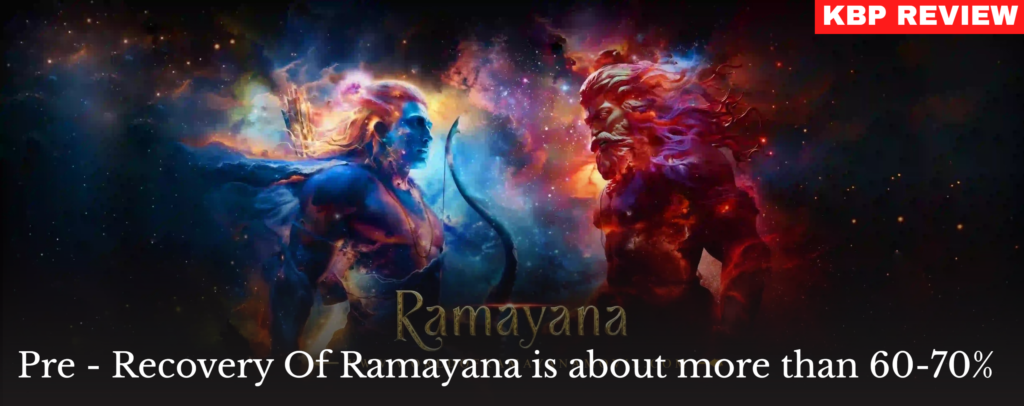
With major theatrical, music, OTT and international deals already in discussion, Namit Malhotra’s epic could enter cinemas with a huge portion of its investment already recovered.
There is a reason why Ramayana is being discussed as more than just another big-budget Bollywood film. The Ranbir Kapoor and Yash starrer has reached an unprecedented scale, and even before Part 1 reaches theatres, the business surrounding the film is becoming a story of its own.
Nitesh Tiwari directs Ramayana, while Namit Malhotra produces it. The film is reportedly being made at a massive cost, with various industry reports placing the combined two-part investment at around ₹4,000 crore, while earlier reports had put the first part’s production cost in the ₹1,500-1,600 crore range.
The makers have not officially disclosed the exact accounting of the two films, so reports can vary. But if we put the reported rights values and existing commercial commitments together, the picture becomes extremely interesting. Based on the available figures, Ramayana: Part 1 could potentially recover a very large portion of its cost even before its theatrical release.
₹1,047.5 Crore Recovery Model: How Does It Add Up?The biggest component in the current calculation is the North Indian theatrical distribution business, which trade circles have widely discussed around the ₹350 crore mark.
As KBP REVIEWS reports, Dharma Productions and Karan Johar have been linked to the Hindi theatrical rights, although the ₹350 crore figure should still be treated as a reported valuation rather than a formally confirmed completed deal.
For the purpose of this recovery model, however, ₹350 crore counts as the potential North Indian theatrical recovery. The music rights of Ramayana have reportedly attracted significant interest, with recent reports suggesting that the makers are looking for a major benchmark-setting deal. Moneycontrol reported that Sony Music had offered around ₹70 crore while the makers were seeking ₹100 crore for the global music rights.
The music business could stand around ₹75 crore for both parts. If we consider that ₹75 crore figure on an advance basis and divide it equally between the two films, Part 1’s notional share would come to approximately ₹37.5 crore.
Importantly, an advance-based music deal does not necessarily mean the makers give away all future upside. If the agreement includes a profit-sharing structure, the producers could potentially earn additional money from the success of the soundtrack.
There have been reports of a massive ₹700 crore OTT proposal for both parts, which Namit Malhotra reportedly did not accept. If that figure eventually gets surpassed, the streaming component could become the biggest non-theatrical recovery in Indian cinema.
For this particular calculation, let’s take a hypothetical ₹850 crore valuation for both parts, rather than presenting it as a confirmed deal. That would mean approximately ₹425 crore attributable to Part 1.
Again, this is a projection, not a confirmed OTT sale. The actual streaming deal could be higher or lower depending on the platform, territory, language rights, exclusivity and the final terms the producers negotiate.
The international business is where Ramayana is attempting to play a completely different game. Sony Pictures Entertainment has officially come on board as the film’s global distributor outside India. The partnership was announced in July, with Sony set to handle the international theatrical release.
There have also been trade discussions around Sony’s international investment and marketing commitment. A figure of around ₹235 crore has been discussed in connection with the global arrangement.
That takes the estimated Part 1 recovery to:
• ₹350 crore – North Indian theatrical distribution
• ₹37.5 crore – Part 1 share of reported music advance
• ₹425 crore – hypothetical Part 1 share of an ₹850 crore two-part OTT valuation
• ₹235 crore – reported Sony international commitment/marketing value
Against a working Part 1 budget estimate of ₹1,500-1,600 crore, that would represent roughly 65-70% recovery before theatrical release. And the most important point is that several major revenue streams are still not fully accounted for.
The first is the actual OTT deal. If Namit Malhotra is indeed holding out for a figure higher than the reported ₹700 crore proposal for both parts, the final streaming agreement could push the recovery considerably higher.
Then there are satellite television rights, which could become another major source of revenue given the cultural importance of Ramayana and the enormous television audience for mythology in India. The South Indian theatrical rights are another major piece of the puzzle. Telugu, Tamil, Kannada and Malayalam markets have not been fully factored into this calculation.
This is why the simple ₹1,047.5 crore figure should not be viewed as the final recovery number. It is better understood as a working calculation based on currently discussed or reported deals.
If the remaining satellite, South theatrical and final OTT businesses get locked at strong valuations, Ramayana Part 1 could potentially move much closer to its production cost before the film even opens. A theoretical 80-90% pre-release recovery is therefore possible under an optimistic business scenario, but it is not yet a confirmed figure.
Therefore, the 80-90% figure should be treated as a trade-based projection rather than an official recovery statement. Still, the fact that such a calculation can even be made for a film costing around ₹1,500-1,600 crore shows how aggressively Ramayana has been monetised.
According to Bollywood Hungama, Ramayana has brought together more than 10,000 crew members from across the world, including specialists working in production design, VFX, action, costumes and other technical departments.
Namit Malhotra’s Prime Focus Studios produces the film in association with DNEG and Yash’s Monster Mind Creations. DNEG’s involvement is particularly significant because the company has won eight Academy Awards for visual effects.
Part 1 is currently scheduled for an international release on November 6, 2026, followed by its India release on November 8, according to the latest announcement. Part 2 is scheduled for 2027, with Ranbir recently revealing that production on the second chapter is already around 50% complete.
ALSO READ: Filmed For IMAX ≠ Shot Entirely With IMAX Film Cameras
There is an important technical distinction that has become increasingly relevant with Ramayana and other Indian films.
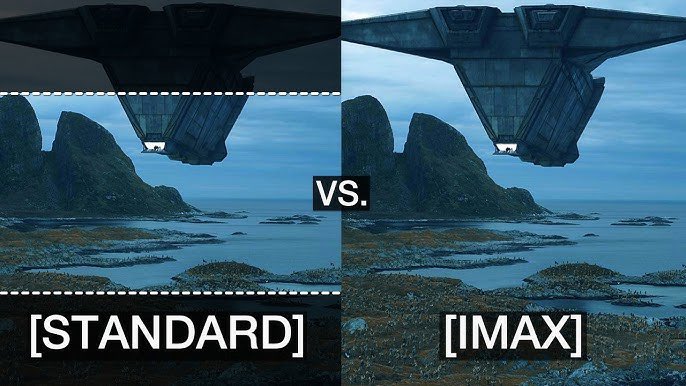
When a movie is described as “Filmed for IMAX,” it does not automatically mean the entire film was shot on 15-perf IMAX 65mm film cameras.
These are two different things: IMAX’s “Filmed for IMAX” programme can involve IMAX-certified digital cameras and other approved capture technologies designed and optimised for the IMAX presentation format. It should therefore not automatically be interpreted as “every frame was captured on an IMAX 65mm film camera.”
Ramayana is officially being promoted as a “Filmed for IMAX” production. The film’s own official presentation uses that terminology. The distinction becomes even clearer when looking at Christopher Nolan’s The Odyssey.
The Odyssey is in a different category: IMAX itself describes it as the first-ever feature film shot entirely with IMAX Film Cameras, using the new generation of IMAX film technology. The production reportedly shot around 2.1 million feet of film.
So, saying Ramayana is “Filmed for IMAX” is accurate. Saying that it was entirely shot on 15-perf IMAX film cameras would be a different claim and should not be made without confirmation from the filmmakers or IMAX.
S.S. Rajamouli’s Varanasi is another Indian project being associated with the IMAX format, but its approach is also worth distinguishing.
The film is being developed with an expanded IMAX presentation, including 1.43:1 sequences, making it particularly interesting for audiences with access to full-height IMAX screens. However, the presence of 1.43:1 sequences should not automatically be interpreted as meaning the entire movie was shot on 15-perf IMAX film.