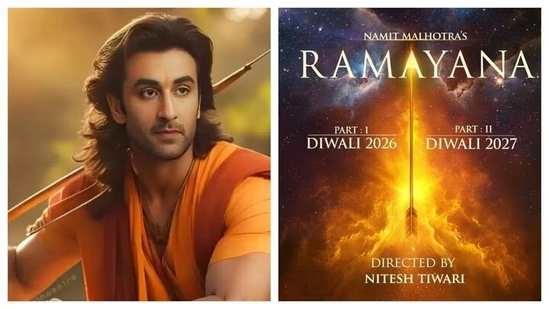


With reports of ₹1,450 crore already being sought from OTT and distribution deals alone, Ramayana is shaping up to be the most valuable Indian film property ever created.
There are big films,
There are event films,
And then there is Ramayana.
Every few years, Indian cinema witnesses a project that goes beyond being just another movie. It becomes a cultural event, a trade phenomenon, and a business case study all at the same time.
The upcoming Ramayana, produced by Namit Malhotra and directed by Nitesh Tiwari, is rapidly becoming exactly That. Long before audiences get their first full trailer, long before advance bookings open, and long before box office numbers begin dominating headlines, the film is already making waves in trade circles because of one simple reason: The money involved & it’s Visuals Going To Be Epic.
A Source By KBP Review, Namit Malhotra has reportedly quoted a staggering ₹1,450 crore through just two revenue streams.
The reported breakdown is equally shocking:
• ₹1,000 crore for OTT rights of both parts in Indian languages
• ₹450 crore for Hindi theatrical distribution rights of Part 1 alone
If these numbers are even close to what is expected, Ramayana will break the record for the highest pre-release business in Indian cinema history.
And Several major revenue streams are still not on the table,
The ₹450 Crore Hindi Distribution Gamble
Let’s start with what has generated the biggest discussion among trade experts, Namit Malhotra has asked for approximately ₹450 crore for the Hindi distribution rights of Ramayana Part 1.
Traditionally, even India’s biggest stars rarely command distribution deals at such levels, The figure immediately places Ramayana in a completely different league.
Trade analysts believe the confidence stems from multiple factors:
The Ramayana is not merely a popular story, It is arguably the most recognizable narrative in Indian culture & Generations have grown up with the story.
Every household knows Lord Ram, Sita, Lakshman, Hanuman and Ravana, This gives the film a level of built – in awareness that most productions can only dream about.
Second, it’s casting… Ranbir Kapoor as Ram, Yash as Ravana, Sai Pallavi as Sita, Sunny Deol as Hanuman.
The cast itself combines pan – Indian appeal across multiple markets.
Third, it’s about scale.
The Creators who have seen portions of the film continue describing the visuals as unlike anything previously attempted in Indian cinema.
That perception alone significantly boosts trade confidence.
Why Part 2 Could Become Even Bigger ;
The ₹450 crore discussion is only about Part 1.
The more interesting question is:
What happens if Part 1 works?
Historically, successful franchises witness explosive growth in rights valuations for sequels For an example It’s DhurandharTheRevenge .
If Ramayana Part 1 performs according to industry expectations, the distribution rights for Part 2 could potentially exceed the current figures by a significant margin.
Part 2 contains many of the most iconic portions of the epic.
The Ram – Ravana war,Hanuman’s larger involvement,The emotional ending of the story.
These elements naturally carry enormous commercial appeal.
As a result, distributors may be willing to pay substantially higher premiums.
The ₹1,000 Crore OTT Discussion,
The OTT valuation may be even more remarkable.
By the Reports approximately ₹1,000 crore is being sought for Indian-language digital rights of both parts combined.
It’s one of the largest streaming Purchased in Indian entertainment history.
Why would OTT platforms consider such a deal?
The answer is simple: Reach.
Unlike many theatrical blockbusters that rely heavily on urban audiences, Ramayana has universal Reach.
Children know the story,
Parents know the story,Grandparents know the story,Regional audiences know the story,International Indian audiences know the story.
Very few entertainment properties possess such cross-generational appeal.
OTT platforms thrive on repeat viewing.
And Ramayana may possess exactly that quality.
Families could potentially revisit the film repeatedly, significantly increasing long-term platform engagement.
The Revenue Streams Nobody Is Talking About
The current discussions largely focus on OTT and theatrical distribution.
However, several massive rights categories remain unaccounted for.
These include;
• Music Rights
• Hindi Overseas Rights
• Regional Overseas Rights
• English Version Distribution
• Foreign Language Distribution
• Satellite Rights
• English OTT Rights
• International Streaming Rights
• Ancillary Licensing Rights
And each of these could contribute substantial additional revenue.
The Music Rights Could Be Massive;
Music remains one of the strongest revenue drivers in Indian cinema. However, Music Is Composed By Legendary A.R.Rahman & Hans Zimmer.
The combination of devotional themes, emotional storytelling and epic orchestration creates enormous potential.
Unlike regular commercial films that depend on chartbuster dance numbers, Ramayana has the opportunity to create timeless musical compositions.
Given the scale of the film, valuations between ₹80 crore and ₹100 crore are frequently being discussed within trade circles.
And if the soundtrack connects with audiences, the final value could potentially rise even further.
Satellite Rights Could Surprise Everyone ;
Many people underestimate television rights today because OTT dominates headlines, That would be a mistake.
The Ramayana remains one of India’s most television-friendly properties.
Television audiences across Hindi, Tamil, Telugu, Kannada and Malayalam markets continue consuming mythological content at exceptional levels.
The original Ramayan serial became a cultural phenomenon.
Even reruns years later attracted massive viewership.
A modern cinematic adaptation featuring major stars could command extraordinary satellite valuations.
Multiple broadcasters would likely compete aggressively,This creates another major revenue stream before release.
The English Version Factor; One of the most intriguing aspects of the project is its global ambition.
The makers are actively positioning Ramayana for international audiences.
This opens another entirely separate business avenue, English-language rights.
Unlike traditional Indian films that primarily depend on diaspora audiences, Ramayana aims to reach mainstream international viewers.
The film could generate substantial value from English-language distribution and streaming deals, The comparison often made by industry observers is not another Indian film.
It is properties like Lord of the Rings, Gladiator, Avatar and Dune, That alone reveals the scale of ambition.
Overseas Markets Are Becoming Increasingly Important; Indian films no longer depend solely on domestic box office.
North America.
United Kingdom.
Australia.
Middle East.
Europe.
South-East Asia.
All have become important contributors to overall revenue.
The presence of stars like Yash and Ranbir Kapoor significantly strengthens overseas appeal.
If the film delivers on expectations, overseas rights could become another major source of recovery.
The confidence surrounding Ramayana isn’t purely emotional, It is rooted in economics, Trade experts generally evaluate projects using three questions:
And long-term interest remains high because mythology rarely becomes outdated. This combination is exceptionally rare.
The Biggest Risk;
The larger the budget, the higher the expectations. Audiences today are far less forgiving than they were a decade ago. Visual effects must be world-class. Performances must feel authentic.
If the execution fails, even the strongest intellectual property can struggle. That is why every decision surrounding Ramayana is being watched so closely.
The stakes are genuinely enormous.
From OTT rights and theatrical distribution to music, satellite, international releases and licensing opportunities, the project has multiple revenue streams capable of generating extraordinary value.
The most fascinating aspect is that a substantial portion of the investment may potentially be recovered before audiences even purchase their first ticket.
That level of pre-release confidence is almost unheard of in Indian cinema.
And if the film delivers creatively alongside its commercial ambitions, Ramayana could become more than just a blockbuster.
It could become the blueprint for how future Indian mega budget films are financed, marketed and distributed across the world.