
There are stories…
and then there are civilizational forces.
The Ramayana is not merely an ancient religious text. It is one of the oldest continuously living narratives in human history — recited for more than 2,000 years across Asia, shaping societies from India to Indonesia, from Nepal to Thailand, from Cambodia to Bali. Unlike mythology that remains in museums, the Ramayana still breathes in festivals, theatre, names of cities, political thought, family values and moral imagination.
In the 21st century — an era of content wars, identity conflicts, cultural insecurity, and technological acceleration — the Ramayana has the potential to become a soft-power, economic, cultural, educational and psychological game changer.
The Ramayana is not merely an ancient religious text. It is one of the oldest continuously living narratives in human history — recited for more than 2,000 years across Asia, shaping societies from India to Indonesia, from Nepal to Thailand, from Cambodia to Bali. Unlike mythology that remains in museums, the Ramayana still breathes in festivals, theatre, names of cities, political thought, family values and moral imagination.
Why Ramayana will be a Game Changer?
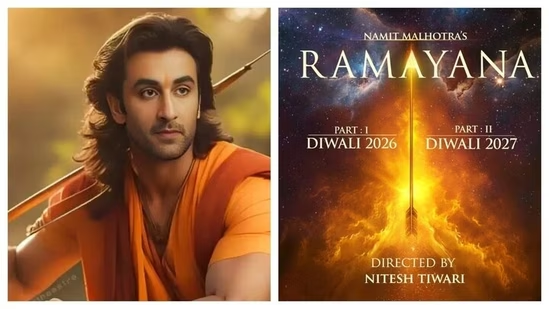
The upcoming Ramayana (2026), directed by Nitesh Tiwari, is not just another big-budget Bollywood film. It is being planned as something Indian cinema has never attempted before — a true global epic. With a two-part structure, international release plans, IMAX scale, and one of the largest budgets ever invested in an Indian production, the film aims to move beyond the category of “mythological movie” and enter the space of worldwide blockbuster storytelling.
For decades, India has been a massive film-producing nation, yet its movies have largely remained domestic successes. Even when films like Baahubali and RRR gained international attention, they were still viewed as regional cinematic achievements. Ramayana is different because its story is already globally recognized. The narrative exists in multiple countries across Asia, with versions performed in Thailand, Indonesia, Cambodia and Nepal. That gives the film something no previous Indian movie has had — a built-in international cultural familiarity.
If executed properly, the film could become India’s first long-term cinematic franchise. The story naturally supports spin-offs and expansions: Hanuman’s adventures, Ravana’s backstory, the Lanka war, and even animated adaptations or games. Essentially, the project has the potential to do for India what the Marvel Cinematic Universe did for Hollywood — create a shared storytelling universe that audiences return to for years.
Another major impact could be technological. One of the biggest criticisms of Indian mythological films in recent years has been weak visual effects. This project is being developed with global-standard VFX pipelines and designed for large-screen viewing. If the visuals meet expectations, producers will finally gain confidence to invest heavily in fantasy, science fiction and large-scale storytelling. That alone could transform India’s animation, gaming and VFX industries.
The film may also solve Bollywood’s identity problem. For years, Hindi cinema has struggled between copying Western action styles and experimenting with social dramas, while audiences increasingly shifted toward South Indian spectacles. Ramayana offers something unique — a story that only Indian creators can authentically tell. Instead of imitation, it represents originality rooted in Indian narrative tradition.
The economic effects could go beyond box office revenue. Successful cultural films often boost tourism and related industries. Locations associated with the epic, especially Ayodhya and other pilgrimage circuits, could see a surge in visitors. Merchandise, streaming rights, music, and global distribution deals could turn the film into a multi-billion-rupee ecosystem rather than a single theatrical release.
But the real significance is cultural. Global pop culture today is dominated by Western superheroes and Japanese anime. If Ramayana resonates internationally, Indian characters like Rama, Sita and Hanuman could become globally recognized figures. That would mean India is no longer just consuming global entertainment — it would be exporting it.
In the end, the 2026 Ramayana is more than a film release. It is a test of whether India can present its own stories at a world-class cinematic level. If it succeeds, it won’t just be remembered as a hit movie. It could mark the moment when Indian storytelling entered the global mainstream.